


The Dovetails standard
What leaves our shop carries our name.
We build in small numbers, answer our own email, and put our hands on every piece before it leaves. These are the standards we hold ourselves to, no matter what we are making.
- Built hereDesigned and made in our workshop. Not outsourced, white-labeled, or bought finished.
- Materials named plainlyWe tell you what a piece is made from, where it matters, and why we chose it.
- Designed for real roomsIt has to work once someone lives with it, not just look good in a photograph.
- Clear expectationsWe tell you what is in stock, what is made to order, and when it should leave the shop.
- We make it rightIf something arrives damaged or is not as it should be, we take care of it.
For this piece
- Solid walnut, solid brass
- Five magnets, one per knife
- Rare-earth N52, concealed
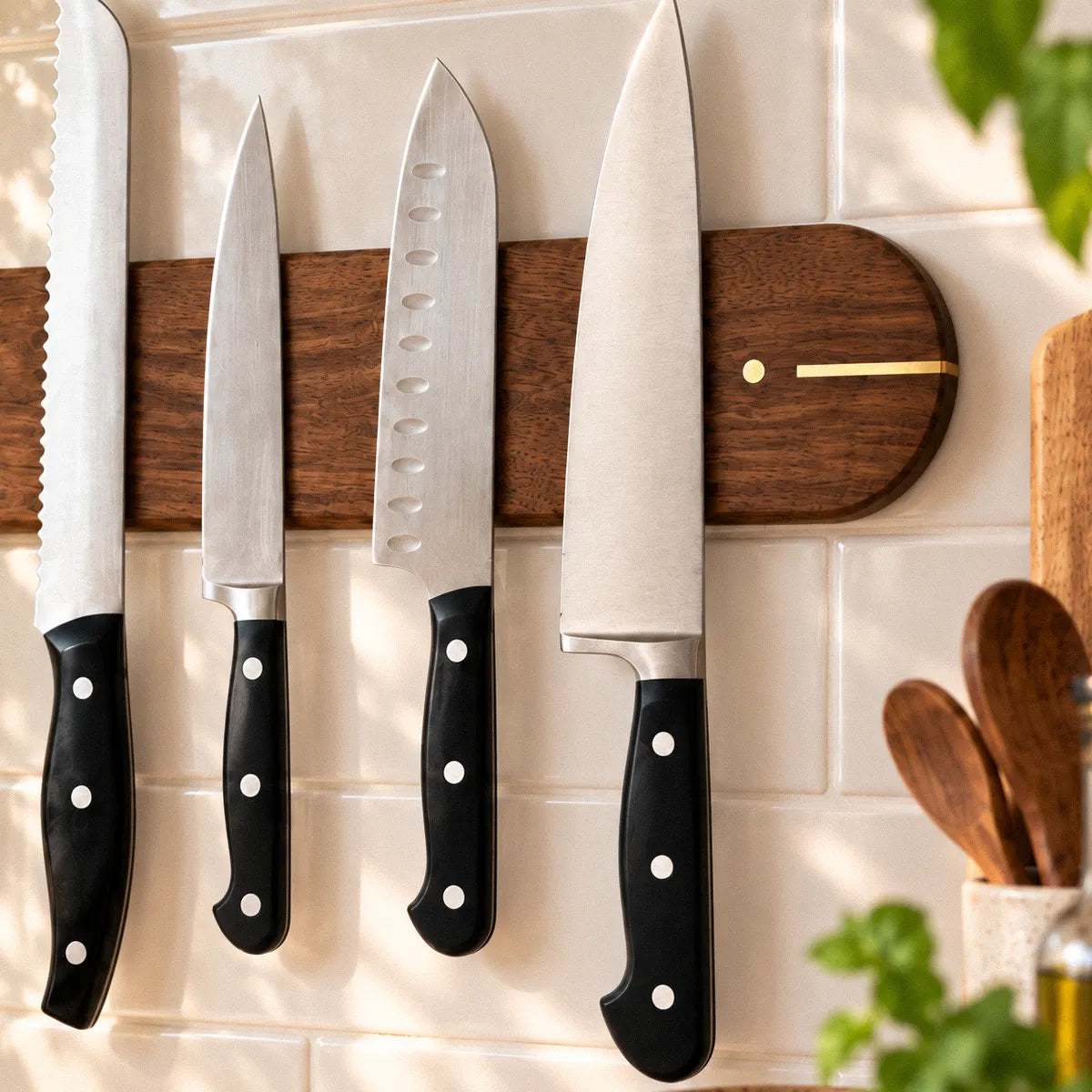
- Inlaid brass bar and pin
- Hidden keyhole mounting
- Made one at a time

The brass
A straight line, a circle, and a little tension.
One of the things we love about mid-century design is how little it sometimes takes to make an object interesting.
George Nelson could take a clock face, reduce it to a handful of lines and circles, and somehow give the whole thing personality. Arthur Umanoff often worked with a similarly restrained vocabulary, putting warm wood beside metal and letting the contrast between the materials do much of the work.
That way of thinking feels very familiar to us.
With Brass Pocket, the walnut came first. We had the long, low shape and the radiused ends, but something about it felt a little too resolved. Too polite.
The brass gave us something to push against that softness.
A straight bar interrupts the walnut. A small round pin answers the curve at the end. At the opposite end, we reverse the arrangement, so the same two shapes finish the piece without simply repeating themselves.
It wasn't until we stood back from it that those old mid-century clock faces came to mind. We hadn't set out to reference a particular designer or object. We had simply ended up speaking some of the same language.
And here's the unusual part for us.
The brass doesn't hold anything. It isn't structural. It doesn't hide the mounting hardware.
It's there because the design needed it.
Sometimes that's a perfectly good job.
George Nelson could take a clock face, reduce it to a handful of lines and circles, and somehow give the whole thing personality. Arthur Umanoff often worked with a similarly restrained vocabulary, putting warm wood beside metal and letting the contrast between the materials do much of the work.
That way of thinking feels very familiar to us.
With Brass Pocket, the walnut came first. We had the long, low shape and the radiused ends, but something about it felt a little too resolved. Too polite.
The brass gave us something to push against that softness.
A straight bar interrupts the walnut. A small round pin answers the curve at the end. At the opposite end, we reverse the arrangement, so the same two shapes finish the piece without simply repeating themselves.
It wasn't until we stood back from it that those old mid-century clock faces came to mind. We hadn't set out to reference a particular designer or object. We had simply ended up speaking some of the same language.
And here's the unusual part for us.
The brass doesn't hold anything. It isn't structural. It doesn't hide the mounting hardware.
It's there because the design needed it.
Sometimes that's a perfectly good job.
The knives
Five knives. Five places.
We spend a lot of time designing a knife rack before there are any knives hanging from it.
But that's only half the composition.
Once five knives go on the wall, they become five strong vertical lines running through a long horizontal one. Their handles are different. Their blades are different. One might be eight inches long and the next five.
So we don't use one continuous magnetic strip and leave the spacing to chance.
Behind the walnut are five N52 rare-earth magnets, each inset from the back and positioned for one knife. Put a knife away and it finds its place.
That keeps the spacing intentional and leaves the face of Brass Pocket exactly as we designed it: walnut, brass and nothing else.
The blade meets wood rather than exposed metal. And because each knife has its own position, they aren't crowded together along one continuous strip.
The rack is only half the design. Your knives finish it.
But that's only half the composition.
Once five knives go on the wall, they become five strong vertical lines running through a long horizontal one. Their handles are different. Their blades are different. One might be eight inches long and the next five.
So we don't use one continuous magnetic strip and leave the spacing to chance.
Behind the walnut are five N52 rare-earth magnets, each inset from the back and positioned for one knife. Put a knife away and it finds its place.
That keeps the spacing intentional and leaves the face of Brass Pocket exactly as we designed it: walnut, brass and nothing else.
The blade meets wood rather than exposed metal. And because each knife has its own position, they aren't crowded together along one continuous strip.
The rack is only half the design. Your knives finish it.

Five magnets, individually placed. Keyhole slots on the back. Nothing on the face but the brass.
Shop note
We went through a lot of names for this one.
Most of them tried too hard to describe it. The walnut. The shape. The mid-century influence. The five knives.
But every time we looked at the finished piece, our eyes went to those little bits of brass.
There isn't much of it. A short bar and a small round pin at each end, set flush into the walnut. Just enough to catch the light before your eye moves back to the wood.
Little pockets of brass.
Brass Pocket.
Sometimes naming a piece takes longer than designing it.
This one didn't.
Most of them tried too hard to describe it. The walnut. The shape. The mid-century influence. The five knives.
But every time we looked at the finished piece, our eyes went to those little bits of brass.
There isn't much of it. A short bar and a small round pin at each end, set flush into the walnut. Just enough to catch the light before your eye moves back to the wood.
Little pockets of brass.
Brass Pocket.
Sometimes naming a piece takes longer than designing it.
This one didn't.
CARE: Just wipe with a damp cloth. The piece and the brass is lacquered, so it needs nothing beyond a wipe with a soft cloth. Do not use metal polish on it.
Specifications
Every measurement has a reason.

| Length | 18" |
|---|---|
| Height | 3 1/2" |
| Thickness | 3/4" |
| Finish | Satin lacquer |
| Brass | Solid brass inlay, lacquered |
| Weight | Varies by piece, approximately 2 lbs |
| Capacity | 5 knives |
| Magnets | Five, individually placed |
| Magnet grade | Rare-earth N52 |
| Material | Solid walnut |
| Mounting | Hidden keyhole slots |
| Built | One at a time |
In the box
- Brass Pocket magnetic knife rack
- Mounting screws and anchors
- Installation card and care notes
Frequently asked questions
Questions from the other side of the bench.
How many knives does Brass Pocket hold?
Brass Pocket holds five knives. Behind the walnut are five individually positioned rare-earth magnets, one for each knife. That gives every blade a defined place rather than letting the knives collect wherever they land along a continuous magnetic strip.
What kinds of knives will it hold?
Most kitchen knives with magnetic steel blades, including chef's knives, santokus, bread knives and paring knives.
Ceramic knives are not magnetic and will not hold. Some stainless-steel alloys are only weakly magnetic, so if you are unsure about a particular knife, test it with a household magnet first.
Ceramic knives are not magnetic and will not hold. Some stainless-steel alloys are only weakly magnetic, so if you are unsure about a particular knife, test it with a household magnet first.
How does the magnetic knife rack attach to the wall?
Two keyhole slots are routed into the back of Brass Pocket, so the mounting hardware disappears once the rack is installed. The rack sits flush against the wall with no screws, caps or brackets visible from the front.
Will the brass tarnish?
Brass naturally darkens and develops a patina over time. We lacquer the brass in Brass Pocket to slow that process and help preserve its warm, bright finish.
The lacquer won't stop aging forever, but it means you shouldn't need to polish the brass. Just wipe it with a soft cloth when needed.
The lacquer won't stop aging forever, but it means you shouldn't need to polish the brass. Just wipe it with a soft cloth when needed.
How is Brass Pocket different from The Look of Love?
Both hold five knives on individually positioned concealed magnets, but the designs are quite different.
The The Look of Love has an asymmetric, curved form that can be mounted level or given as much as five inches of rake. Brass Pocket is symmetrical, mounts flush on hidden keyholes and has a quieter horizontal profile.
Same job. Very different personalities.
The The Look of Love has an asymmetric, curved form that can be mounted level or given as much as five inches of rake. Brass Pocket is symmetrical, mounts flush on hidden keyholes and has a quieter horizontal profile.
Same job. Very different personalities.
Can I order Brass Pocket in another wood?
For now, Brass Pocket is made in walnut.
If you have another hardwood in mind, go off-menu. Send us a note and we'll tell you whether we think it will work with the design.
If you have another hardwood in mind, go off-menu. Send us a note and we'll tell you whether we think it will work with the design.
How strong are the magnets?
Brass Pocket uses five N52 rare-earth magnets concealed behind the walnut, one for each knife.
Does a magnetic knife holder damage knives?
No. The blade rests against walnut rather than metal, and the magnets sit inside the wood rather than on the surface. Storage like this protects an edge from the knocks it takes in a drawer. It won't sharpen a knife, and nothing that stores one will.
Are the magnets visible?
No. All five magnets are concealed inside the walnut and installed from the back. From the front, you see walnut, the brass inlays and your knives.
Walnut and Brass Magnetic Knife Rack – Brass Pocket
$155.00